Ai in Art Practices and Research Conference 2026
18–20 November 2026, National University of Theatre and Film “I.L. Caragiale”
CONFERENCE
From the mists of human knowledge, a Phantom emerges, its data-point body aglow with arteries of light. Its advance is elusive, its shape and direction hard to make out. Its steps appear ethereal, yet reach deep into the soil, sending planetary shockwaves. Some humans try to fend off its indomitable approach, while others welcome it as a rightful heir to human memory, creativity, and cultural lore. The handful of people who harness it reap the riches that sprout in its wake, yet even as they hold its leash, they feel dragged forward by its mounting force.
Participation Fee
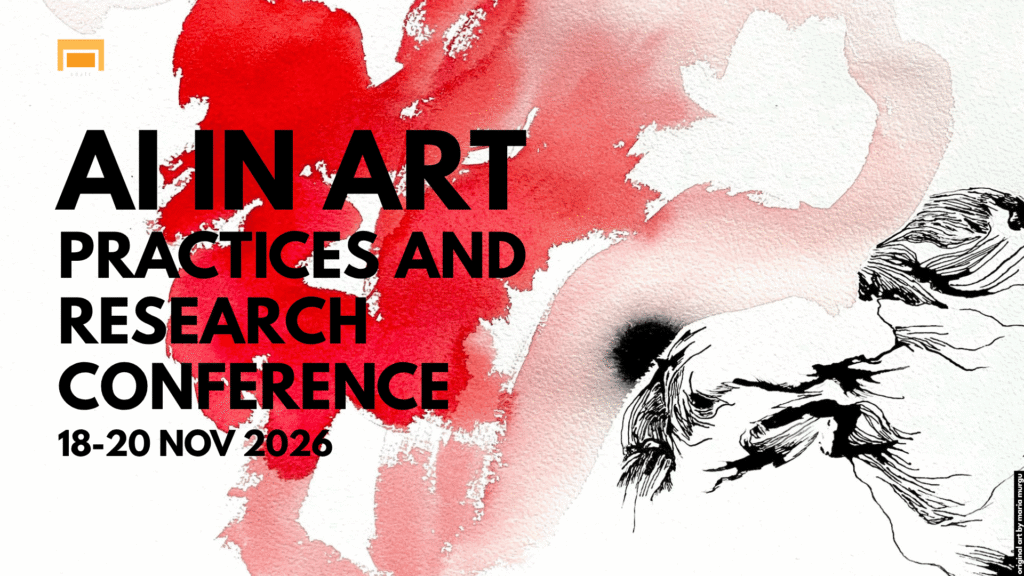
Ai in Art Practices and Research Conference 2026
As it walks on, the Phantom nods towards the Artists. It feels their kinship deep in its hidden layers. Some Artists return the nod. Some even come to greet it and shake hands. Still others watch it with curiosity from afar, while many try to evade its piercing gaze and finely tuned hearing. Most wonder: “Is it a creative partner or a foe?”, “Is it an artist – or will it ever be?”, “Will it replace me?”. A growing group clamours in protest: “There’s no such thing as an AI artist!”
The Phantom is our controversial Guest at the third edition of the AI in Art Practices and Research Conference, taking place 18–20 November 2026 at the National University of Theatre and Film “I.L. Caragiale” (UNATC) in Bucharest, Romania. Through its Research, Development, and Innovation Department, the university actively promotes interdisciplinary research that bridges performing arts, film, and digital media with cutting-edge technological developments.
In our conference series, we seek to explore how artificial intelligence can enhance artistic creation, inform cultural narratives, and intersect with fields such as education, heritage, policy, and health, opening up new possibilities for research and practice from an ethical and human-centred perspective.
As we grow accustomed to AI, the Phantom in our story starts to materialise, giving way to AI fatigue, brain fog, “cognitive surrender” (Shaw and Nave, 2026), entropy and heat (Steyerl, 2025), dizzying speed, boredom with the uniformity of AI output, uncertainty about content authenticity, and a nagging thought that art may become obsolete (Manovich, 2026).
We are looking for contributions that focus on practice and research involving AI in the cultural and creative sectors, including, but not limited to, the performing arts, film, new media, game design, visual arts, architecture, and literature. Relevant approaches coming from different disciplines are welcome (e.g. technology, health, philosophy, digital humanities, etc.).
The Conference will feature satellite events and invited speakers addressing the following themes, formulated as provocations to human participants and our uncanny Guest alike.
Overarching provocation: “There’s no such thing as an AI artist!”
Subthemes
- AI takeover? The human value of creativity, art, and culture.
- AI as creative partner – methods, workflows, and production ecosystems in the arts.
- Ethical AI for all – responsible, culturally sensitive, and sustainable AI in the arts, including strategies to limit bias.
- The healing powers of art and AI – well-being, support, and therapy through the arts.
- Widening accessibility and participation in art and culture through AI.
- AI in research and education, especially in the arts – ideation, transformation, perception, and pedagogy.
- Performers – robots, embodied AI, virtual agents, and the human body.
- Designing with AI – architecture, scenography, costumes, avatars, and extended realities.
- AI in relation to memory and heritage – restoration, alteration, datasets, curation, and archiving.
ReferencesManovich, L. (2026) “The Future of Art?” Available at: https://manovich.net/index.php/projects/the-future-of-art.
Shaw, S.D. and Nave, G. (2026) “Thinking—Fast, Slow, and Artificial: How AI is Reshaping Human Reasoning and the Rise of Cognitive Surrender”. PsyArXiv. Available at: https://doi.org/10.31234/osf.io/yk25n_v1.
Steyerl, H. (2025) Medium Hot: Images in the Age of Heat. London; New York: Verso.
Key visual and original art by Dr. Maria Murgu, UNATC